
Search these docs, or ask Revo a question — answers link the pages they came from.
CLARIOstar
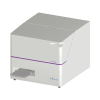 BMG LABTECH CLARIOstar Multimode microplate reader with LVF monochromators.
The BMG LABTECH CLARIOstar is a multimode microplate reader built around BMG’s Linear Variable Filter (LVF) monochromators, which BMG describes as giving filter-like light transmission with continuously adjustable bandwidths. One instrument covers absorbance, fluorescence, luminescence, polarisation, time-resolved and Alpha assays.
BMG launched the original CLARIOstar in 2013 and states it was replaced in 2019 by the CLARIOstar Plus, which is the model BMG sells today. The Revolution driver is named for the CLARIOstar and its source does not distinguish between the original and the Plus. The specifications below are the ones BMG publishes for the CLARIOstar Plus.
At a glance
Section titled “At a glance”| Type | Multimode microplate reader with LVF monochromators, filters and a UV/vis spectrometer |
| Detection modes | Absorbance, fluorescence intensity (incl. FRET), luminescence (incl. BRET), fluorescence polarisation, time-resolved fluorescence, TR-FRET, AlphaScreen, nephelometry |
| Plate formats | 6- to 1536-well, user-definable |
| Instrument software | Voyager and SMART Control for reader control; MARS for data analysis |
| Revolution control | None yet — the driver is a scaffold. Its only operation writes a message to the log. |
Specifications
Section titled “Specifications”BMG LABTECH publishes the following for the CLARIOstar Plus on its product page.
| Filters (FI, FP, TRF) | 240–740 nm; 240–900 nm with the red-shifted PMT |
| LVF monochromators (FI) | 320–740 nm; 320–840 nm with the red-shifted PMT |
| Luminescence | 240–740 nm (filters); 320–740 nm (LVF monochromators) |
| Linear variable dichroic mirror | 340–740 nm; 340–760 nm with the red-shifted PMT |
| Absorbance spectrometer | 220–1000 nm, wavelength precision ≤0.5 nm |
| Plate formats | 6- to 1536-well, user-definable; LVis Plate with 16 microspots of 2 µL |
| Read times, 1 flash / 10 flashes | 96-well 8 s / 19 s; 384-well 15 s / 57 s; 1536-well 28 s / 3 min 4 s |
| Reagent injectors | Up to 2 built-in; 3–500 µL per well (optionally up to 2 mL); up to 420 µL/s |
| Incubation | 3 °C above ambient up to 45 °C or 65 °C |
| Shaking | Linear, orbital and double-orbital, user-definable time and speed |
| Software | Voyager and SMART Control (reader control), MARS (data analysis); FDA 21 CFR Part 11 compliance available with SMART Control and MARS |
| Dimensions (W × D × H) | 45 × 51 × 40 cm |
| Weight | 32 kg |
BMG also lists Enhanced Dynamic Range and rapid full-plate autofocus for the Plus, and states that together they remove the need for a manual gain setting when bright and dim signals are read in one run. BMG notes that Voyager is compatible from serial number 430-4001 onward, which matters if your instrument is an older unit.
BMG states the CLARIOstar Plus is for research use only.
Supported methods
Section titled “Supported methods”None that reach the instrument. The Revolution driver for the CLARIOstar is a scaffold: it registers the device and its model so that a system can be configured against it, and it does not yet open any connection to the reader. Initialising the device logs that no instrument connection is made.
- Debug — writes the given message to the device log and does nothing else. It exists so the scaffold can be exercised from a schedule; no command reaches the reader.
A schedule cannot start a read, run a protocol, move the plate carrier or query the instrument’s state through this driver. Unlike the PHERAstar driver, it also does not drive the plate carrier out and in around a robot transfer, so the carrier has to be in the load position by other means. Any measurement made while a plate sits at the CLARIOstar is started outside Revolution.
Integration
Section titled “Integration”There is no transport configured: no serial or network connection, and no BMG software in the path. BMG’s own control software (Voyager or SMART Control) is how the instrument is operated today, and the Revolution driver does not use it.
Prerequisites
Section titled “Prerequisites”- The instrument must be positioned so the system’s mover can reach its plate carrier, and the carrier must be at the load position when a transfer happens. Revolution does not command it.
- Any read must be set up and started in BMG’s software at the instrument. A schedule step cannot do it.
- Timing must be arranged by hand. Revolution cannot ask the reader whether it is busy, so a schedule cannot wait on a read finishing.
Device configuration
Section titled “Device configuration”| Property | Purpose |
|---|---|
| — | The driver declares no configurable device properties. Only the standard device settings apply. |
If you need more of this instrument driven from a schedule, get in touch — the driver is extended on demand.
Operations
These are available from a Run Device Operation step.
Debug
Writes the given message to the device log and does nothing else. This driver is a scaffold awaiting implementation, so no command reaches the instrument.
| Parameter | Type | Default | Description |
|---|---|---|---|
| message | string | CLARIOstar debug |
Raise Error
Makes this device report a failure on demand: the step fails with an error naming the device, and the operator is offered the usual error recovery choices. No command reaches the instrument and nothing moves, and the failure is raised in simulation as well as on a real system, so this is the step to use when rehearsing how a schedule handles a device failure.